You are hereFeatures
Features
Nicoli Nattrass: The Spectre of Denialism
 AIDSTruth contributor Prof Nicoli Nattrass (director of the AIDS and Society Research Unit at the University of Cape Town) has written a new book The AIDS Conspiracy: Science Fights Back, published by Columbia University Press. In the book, she explores conspiracy theories on the origins of AIDS (such as that it was manufactured by the US government), their surprising longevity, the campaigns by scientists to correct misinformation and the consequences of these myths for behaviour.
She reflects on some of the arguments in the book in a piece for The Scientist, which has also published a short extract of the book on its website.
There is a substantial body of evidence showing that HIV causes AIDS—and that antiretroviral treatment (ART) has turned the viral infection from a death sentence into a chronic disease.1 Yet a small group of AIDS denialists keeps alive the conspiratorial argument that ART is harmful and that HIV science has been corrupted by commercial interests. Unfortunately, AIDS denialists have had a disproportionate effect on efforts to stem the AIDS epidemic. In 2000, South African President Thabo Mbeki took these claims seriously, opting to debate the issue, thus delaying the introduction of ART into the South African public health sector. At least 330,000 South Africans died unnecessarily as a result.2,3
The “hero scientist” of AIDS denialism, University of California, Berkeley, virologist Peter Duesberg, argues that HIV is a harmless passenger virus and that ART is toxic, even a cause of AIDS. He has done no clinical research on HIV and ignores the many rebuttals of his claims in the scientific literature.4,5 As I describe in my new book, The AIDS Conspiracy: Science Fights Back, this has prompted further direct action against Duesberg by the pro-science community.
What do we know about AIDS deaths in South Africa?
By Nathan Geffen
The obscure Italian Journal of Anatomy and Embryology has published an article by AIDS denialist Peter Duesberg packed with errors. It claims that data from Uganda and South Africa shows that there is no evidence of an HIV epidemic. This journal, whose title indicates no expertise in HIV, has a track record of publishing peer-reviewed AIDS denialist nonsense.
The article will have no influence on medical science. Nor is it likely to influence the South African government; the days of state-supported AIDS denialism are gone. Nevertheless its publication and the subsequent unnecessary publicity it received in the world's leading science journal, Nature, provide a good opportunity to explain how we do know there is a massive HIV epidemic in South Africa.
The two main arguments Duesberg et al. offer are that (1) the population has increased by 20 million in the past three decades and (2) mortality reports released by Statistics South Africa (Stats SA) show relatively few AIDS deaths.
The first argument, that the population has increased, can be swiftly dealt with. Read more »
A note from a childhood friend of Kim Bannon
by Phillip L. Murphy
This note first appeared on a Facebook page. It is republished here with the author's permission.
After speaking with Shannon, we decided it would be beneficial to those interested in Kim's history to hear my own personal story.
I was diagnosed with HIV in the fall of 1984. It was my final year of undergraduate work at KU, and i was deciding whether to attend medical school. after receiving the news in a very seedy sedgwick county health department office, I was terrified, horrified and in shock. I had been in a monogomous relationship with a man for almost a year. He began to hear rumors that a man he had dated previously was "sick". After his test results came back positive, it was my turn. Neither of us knew what to do or where to turn. In those days there was talk of quaranteening the infected in asylums or deserted islands. We were a pariahs, angels of death. From that moment on we couldn't plan for our futures or make decisions beyond what was for dinner because we expected to drop dead at any moment. That is what was happening to those in our situation. Read more »
Videos: Myths about HIV/AIDS debunked
These two videos from AIDSVideos.org do a good job debunking some of the myths about HIV tests and about HIV/AIDS.
Kerry Cullinan: Frank Chikane’s whitewash of Mbeki is an ahistorical disgrace
This opinion piece by Kerry Cullinan appeared on the Health-e News Service:
OPINION: Doctors call them Thabo’s children – the thousands of kids infected with HIV by their mothers at birth who still fill hospital paediatric wards, suffering from a range of debilitating infections.
When many of them were born, they did not get antiretroviral medication that could have prevented their mothers from passing HIV on to them. This was because then-president Thabo Mbeki had decided that ARVs were “toxic” and somehow less desirable than a fatal, incurable virus.
But by 2000, at the height of Mbeki’s AIDS debating society, four independent studies had shown that two ARVs, AZT and nevirapine, could cut HIV transmission from mothers to babies by up to 50%.
Also by 2000, research showed a radical change in the death patterns of South Africans with a peak in young women and men, rather than the elderly, that could only be explained by AIDS.
It is well documented that some 330,000 people died under Mbeki’s watch because his government delayed the introduction of ARVs.
What is less known is that Mbeki’s refusal to accept that AIDS was caused by a viral infection caused his government to under-fund health services at the very time that hospitals were starting to see a surge in AIDS patients. They closed nurses’ training colleges and flat-lined health budgets to save money, hastening the collapse of health services that we see today.
Yet in a series of articles published in Independent newspapers countrywide recently, Mbeki’s loyal director general, Frank Chikane, has tried to portray his former boss as a deep thinker who took a principled stance after thorough research. Read more »
In Defence of Science: Seven points about traditional and scientific medicine
by Nathan Geffen, 28 August 2010
This is a corrected version of a position argued by the author at a debate that took place at the University of Cape Town in August 2010 about traditional and scientific medicine. Geffen is the treasurer of the Treatment Action Campaign, but this paper presents his personal views only. He is also author of the book Debunking Denialism (Jacana 2010)
Scientists can be elitist and patronising. In that way, they are no different to any other people with power, including some traditional healers and including people who defend science, like myself.
There are multiple knowledge systems. Cultural diversity, including African culture, is a valuable treasure. Traditional medicine is used by people across the world. African traditional medicine, in particular, is used by millions of people across Africa. It is therefore important to build relationships with traditional healers to ensure that their patients receive appropriate care. Many organisations, such as the Treatment Action Campaign (TAC), attempt to do this, with varying degrees of success.
However, In critiques of medicine and, on the other hand, efforts to accommodate traditional healing, humanities researchers sometimes stand accused of being relativist, i.e. promoting or implying multiple incompatible positions as being true or valid. They also sometimes stand accused of being less than forthright about the problems with traditional healing. With this in mind, I present seven frank points which I hope will inform this discussion. Read more »
The Cult of HIV Denialism
By Jeanne Bergman, Ph.D.
Achieve, Spring 2010. Reprinted with permission from Achieve.
Introduction
More is known about HIV than about any other virus. Less than three decades ago, doctors were perplexed by the appearance of Kaposi's sarcoma and Pneumocystis pneumonia (PCP) in young gay men. Since then, scientists and doctors, spurred by the activism of people with AIDS, discovered the virus now called HIV and proved that it causes AIDS by crippling the immune system until the body can no longer resist life-threatening infections.
Scientists around the world have isolated HIV, photographed it with electron microscopes, and sequenced the genomes of its different subtypes. There are now highly accurate tests for HIV antibodies and the virus itself, and increasingly effective and tolerable antiretroviral drugs (ARVs) for its treatment. Science is a gradual process, and there is still much that is not fully understood about HIV, but the evidence that HIV exists, is transmissible by blood, semen, and vaginal fluids -- and that it causes AIDS -- is vast and thorough. Read more »
AIDS Denialism, Medical Hypotheses, and The University of California’s Investigation of Peter Duesberg
AIDStruth.org, April 2010
AIDS denialist and U.C. Berkeley Professor Peter Duesberg has recently received media coverage following the withdrawal of a paper of his by the publisher, Elsevier, and an investigation into his conduct by the University. [1] Here, we provide some background and a timeline of events in the unfolding drama.
AIDS denialism, which Peter Duesberg has promoted tirelessly for the past quarter century, has claimed many victims from the ranks of HIV-positive people who believe in its tenets: that HIV is harmless or non-existent, antiretroviral drugs (ARVs) cause AIDS, and lifestyle choices and alternative therapies can prevent AIDS-related illness and death. [2] These deaths, caused by the fusion of ignorance and lies, are regrettable and tragic. They are dwarfed in scope, however, by what happened at the end of the millennium in South Africa. There, hundreds of thousands of people died when the apparatus of state was placed in service of Duesberg’s theories on HIV and AIDS. Read more »
Statement by Nathan Geffen on Complaint Against Peter Duesberg
Two media articles create the impression that I complained anonymously about Peter Duesberg to the University of California Berkeley. These are:
There was nothing anonymous about my complaint. I believe that Duesberg failed to declare a conflict of interests of one of his co-authors in an article published in a journal called Medical Hypotheses. I consequently lodged a complaint with the University. I believe high quality journals should hold the first author responsible for a failed declaration of conflict of interests by co-authors (unless the co-author hid the conflict from the first author which is definitely not the case here). Duesberg was the first author of this article. Admittedly, Medical Hypotheses is not a high quality journal.
On 9 April 2010 UCB emailed me asking if I was prepared to have my complaint given to Duesberg in full with my name on it. I unhesitatingly answered yes immediately upon receipt of the email. My complaint has never been anonymous. Read more »
Quackery taken to task
by Lesley Odendal
First published by health-e. This article is republished by AIDSTruth because it deals with political support for AIDS denialism.
OPINION:Nathan Geffen’s book Debunking Delusions reminds us what can go wrong when AIDS denialists are given the time of day. The book also documents clearly how we can fight denialism in a manner that saves lives and respects science. What is clear given the resurgence of AIDS denialist propaganda is that now is not the time to sit back.
As Geffen argues in his book, underlying the Treatment Action Campaign’s success in fighting denialism and quackery was the almost unsung treatment education programme. Knowledge truly is power in this case. Read more »
The Price of Denial: A documentary on the legacy of AIDS denialism in South Africa
This documentary was produced by the non-profit health news agency Health-e and was recently broadcast on an independent television channel in South Africa. View Part I:
(If you do not see the video above, your browser does not support HTML5 video playback. Download the video or visit this page in Firefox or Chrome.) Download Part I in ogg/theora or in mp4. Part II after the jump. Read more »
New myth debunked: The fact that some HIV-positive people live in good health without treatment for many years proves that HIV is harmless
Fact: A small percentage of people infected with HIV do live for many years without developing AIDS. They are often known as long-term non-progressors. But such individuals are rare: without proper medical care, including antiretroviral drugs when needed, most HIV-positive people will eventually develop AIDS.
As putative evidence that HIV is harmless, some HIV/AIDS denialists point to examples of HIV-infected people who survive for many years, even decades, without receiving antiretroviral treatment. HIV denialists often claim that these people survived because they avoided antiretroviral therapy, and that diet, exercise, nutritional supplements or herbal therapies, stress reduction, hypnosis, and other interventions prevent progression to AIDS. These claims are untrue and dangerous.
In Memoriam, Lambros Papantoniou
by George N. Pavlakis, Rockville, MD USA
What do you do about someone who claims to be an expert, serving up half-truths, twisting the facts in credible-sounding sentences and misleading a patient? There must be some rules that apply to someone who professes to be an expert and induces patients to stop their doctor-prescribed medication. These must be applied to prevent harm to more patients. And what if these actions lead to the patient’s death?
Such is the case of Lambros Papantoniou, a journalist living in Washington, a diplomatic correspondent for several Greek media institutions for more than 30 years and a man loved by all who met him. Even in the higher political echelons of Washington, he was affectionately known as “Mr Lambros”.
During a hospital stay approximately ten years ago, Lambros was diagnosed with AIDS and given anti-retroviral therapy. Following this, his interest in the AIDS problem skyrocketed, and he sought information on it. Although he was a diplomatic correspondent, he reported on AIDS issues several times. Read more »
Rian Malan still getting AIDS stats wrong
by Nathan Geffen, 1 December 2009
Substantially updated by the author on 7 December 2009
In a piece published in Rapport newspaper and on politicsweb, Rian Malan claims:
[D]on't trust anything the Aids bwanas say - especially not Nathan Geffen of TAC. Earlier this week, he informed the world that Zuma's mistake "was of little consequence," because other data showed that SA's death rate has doubled since l997. Hmmm. It is true that annual death registrations rose from 316,000 in 1997 to around 600,000 in 2007, but it is absurd to claim, as Geffen did, that this was almost entirely the result of Aids.
Over the same period, completeness of registration rose from around 67 percent to 81 percent, according to Stats SA, while our population rose by close on seven million. If you adjust the raw numbers accordingly, Geffen's apparent doubling shrinks to an increase of around 15 to 20 percent.
He then published a correction:
Correction: I am informed that my mathematical skills leave much to be desired. If you run the numbers in the penultimate paragraph correctly, the real increase in SA death registrations since l997 comes out at around 30 percent - still a tragedy by any reckoning, but still way short of the doubling claimed by Geffen.
First let's deal with the numbers. Malan continues to get it wrong, even in his correction. AIDS deaths have conservatively increased 6-fold since 1997, from approximately 50,000 to well over 300,000 in 2006 as well as 2007 and maybe even over 350,000, meaning the real increase in deaths -which is way more than 30%- recorded or otherwise, was mainly due to AIDS. The ASSA2003 interventions model calculates under 150,000 AIDS deaths in 2000 and about 360,000 in 2007. Approximately 45% of deaths in 2006 and 2007 were due to AIDS. The model probably overestimates AIDS deaths but not substantially enough to give any material support to Malan's argument. But even a 30% increase in mortality, as Malan acknowledges, is a tragedy. Read more »
Constantine and Weiss pinpoint misrepresentations
Statements by Professor Niel Constantine and Professor Robin Weiss about the Misrepresentation of their Interviews in “House of Numbers.”
Posted November 23, 2009, to HouseofNumbers.org
The sections on HIV antibody tests in “House of Numbers” contain fragments of interviews with a number of different people, put together in a way that confuses viewers rather than clarifying what HIV testing protocols are and how they work. The editing of the interviews to try to create doubts about the worth of HIV diagnostic assays is surely intentional. Questioning HIV diagnostics is one of the main tactics of HIV denialism.
The talking heads in these sections of the video include an eager-to-please but inexpert woman working in a temporary testing tent in a South African mall, several legitimate scientists, and HIV denialist Liam Scheff and filmmaker Brent Leung. The section jumbles together bits of speech about the use of HIV antibody testing for different purposes—for screening the blood supply, for screening individuals for HIV infection and confirmatory testing, for diagnosis and for prognosis. It also scrambles remarks about different generations of tests; about tests of different qualities—those manufactured under FDA oversight and those produced in uncontrolled conditions; about different types of HIV antibody tests—conventional and rapid tests, ELISA and Western Blot; and about the use of these tests under different countries’ government protocols—Germany, South Africa, Britain, the USA. The resulting mess of words creates confusion – as it was intended to.
The history, variety, and protocols of HIV antibody testing can be confusing to non-experts. Leung and his team have exploited this in the film. But any of the legitimate scientists or clinicians in the film, asked a clear question by an ethical interviewer who would try to present their views accurately, could easily explain how HIV antibody testing works, what protocols are used to maximize accuracy in different places and at different times, the distinctions between screening and diagnostic assays, the differences between ELISAs and Western Blots, and so on. But Brent Leung sought to confuse, not clarify. He wanted to make it seem like the tests are unreliable and that the scientists he interviewed didn’t know disagreed with each other about HIV tests. The reality is very different. HIV antibody tests are extremely accurate, and various confirming protocols (two or three different types of tests) are used in different places. Read more »
Science, pseudoscience and professional responsibility
by Dr John Moore, PhD (Originally published by health-e)
Surveys have consistently shown that over 40% of Americans do not believe in evolution. It is not surprising, then, that our society is vulnerable to being fooled by people who misrepresent scientific or historical facts.
We are now all too familiar with the crazed activities of the 'Birthers', an ad hoc, right wing political group refusing to accept President Obama was born in the United States. Earlier this year, we saw media coverage of the insane views of a clique that refuses to accept American astronauts walked on the moon 40 years ago. The "9/11 Truth Movement" flourishes on the internet, arguing that the World Trade Center and the Pentagon were not hit by hijacked jetliners, but were blown up by the CIA at the behest of Israeli intelligence. Conspiracy groups like these usually do little real damage to society, although the activities of the "9/11 Truth Movement" foster anti-Semitism and insult the memories of the nearly 3000 Americans who died on 9/11. Unfortunately, other equally bizarre and factually unfounded, internet-based conspiracy groups can, and do, harm, even kill, significant numbers of people. This is not just an American problem, as the ripple effects of conspiracy theories spread worldwide via the internet. Indeed, the most serious consequences of one such group’s actions have been felt in Africa. Read more »
The Shameless Rian Malan
by Nathan Geffen, 19 November 2009
In 2001, Rian Malan wrote an article in Rolling Stone questioning the accuracy of HIV tests in order to disparage the evidence of a growing HIV epidemic in South Africa. In 2003 he published similar articles in the Spectator and Noseweek. All these articles were replete with errors. I subsequently debunked the latter two in a January 2004 article.
One of Malan's errors was particularly serious. He presented miscalculated, massively understated estimates of AIDS deaths which he falsely attributed to Stats South Africa. As I wrote then, the mistake was so serious and obvious that it raised questions about Malan's basic competence as a research journalist -or more disturbingly- about his motives and integrity.
In Mbeki's 2004 State of the Nation speech he quoted from Malan and spoke warmly about him. It was not explicitly about HIV, but to anyone following the debate at the time, it was clear that Mbeki was grateful for Malan's support on AIDS. Read more »
AIDS and mortality in South Africa
By Nathan Geffen, 16 November 2009
On 2 November 2009, Statistics South Africa released the latest mortality data, which goes up to 2007 (Stats SA, 2009). This table gives the number of recorded deaths per year:
|
Year
|
Number of recorded deaths by Stats SA
|
|
1997
|
317,131
|
|
1998
|
365,852
|
|
1999
|
381,820
|
|
2000
|
415,983
|
|
2001
|
454,847
|
|
2002
|
502,031
|
|
2003
|
556,769
|
|
2004
|
576,700
|
|
2005
|
598,054
|
|
2006
|
612,462
|
|
2007
|
601,033
|
You do not need to be a statistician to be astounded by this. Recorded deaths have increased over 90% in a decade. Improved death registration and population growth can account for only a small portion of this increase. The vast majority of additional deaths are due to the HIV epidemic. A huge body of evidence shows this. For example, there has been a three-fold increase in TB deaths over the same period and TB is the leading cause of death in people with HIV. Also the age pattern of the deaths --younger instead of older adults comprise the bulk of them-- and the drop in the median age of death from 51 in 1997 to 44 in 2007 are consistent with the way AIDS works. (For more detailed evidence see Dorrington et al. 2006, Dorrington et al. 2001 and Stats SA, 2002). Read more »
How to spot an AIDS denialist
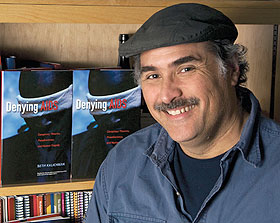
by Seth Kalichman (Originally published in the New Humanist)
Imagine that you or someone you love just received an HIV positive test result. The news is devastating. After a short time you begin to face the diagnosis. You turn to the Internet for answers. Searching the words “AIDS diagnosis” brings up thousands of websites. A whirlwind of information spins your mind. One credible-looking website, Aids.org, reads: “There is no cure for AIDS. There are drugs that can slow down the HIV virus and slow down the damage to your immune system. There is no way to ‘clear’ HIV from the body. Other drugs can prevent or treat opportunistic infections (OIs). In most cases, these drugs work very well. The newer, stronger ARVs have also helped reduce the rates of most OIs. A few OIs, however, are still very difficult to treat.”
With a click of the mouse, an equally credible-looking site, Aliveandwell.org, asks: “Did you know … Many experts contend that AIDS is not a fatal, incurable condition caused by HIV? That most of the AIDS information we receive is based on unsubstantiated assumptions, unfounded estimates and improbable predictions? That the symptoms associated with AIDS are treatable using non-toxic, immune-enhancing therapies that have restored the health of people diagnosed with AIDS and that have enabled those truly at risk to remain well?”
Which do you trust? Which do you believe? Which would you want to believe? Would you choose to believe there may be hope offered by medical treatments or would you prefer to believe that HIV is harmless? This simple example illustrates the lure of AIDS denialism. Read more »
Warning about pseudo-scientific review of alternative AIDS medicines
A website that is advertised via Google ads, is promoting alternative, unproven and untested medicines for the treatment of HIV. The website is http://www.hivsecrets.com. Upon registering with it, a report titled HIV Alternative Therapies Report is made freely available for download. This report is written by a Ms Shirley Wyand. Ms Wyand has no known expertise in the science of HIV/AIDS.
The report is replete with misconceptions. For example, it states, "Since Western medical science offers no cure and few treatments for AIDS, people living with HIV are open to other options, and a tradition of gathering and sharing treatment information already exists." On the contrary, antiretroviral treatment is a very effective chronic treatment for HIV. There are also many effective medicines that treat AIDS-related opportunistic infections. There are no alternative treatments for HIV that have been shown to be effective. Indeed, once a medicine is shown to be effective it is no longer an alternative one.
Another example of the report's misconceptions is that it promotes an untested product called Revivo tea. This products advertisements touting its efficacy for the treatment of HIV have recently been banned in South Africa by that country's Advertising Standards Authority. Read more »
